Governance applied at runtime, token by token.
Chatbots and AI assistants generate answers on the fly — there is no source string to review. Black Ice intercepts concepts as the model reaches them and injects market availability, regulatory disclosures, locked terms, and local constraints before they reach the user.
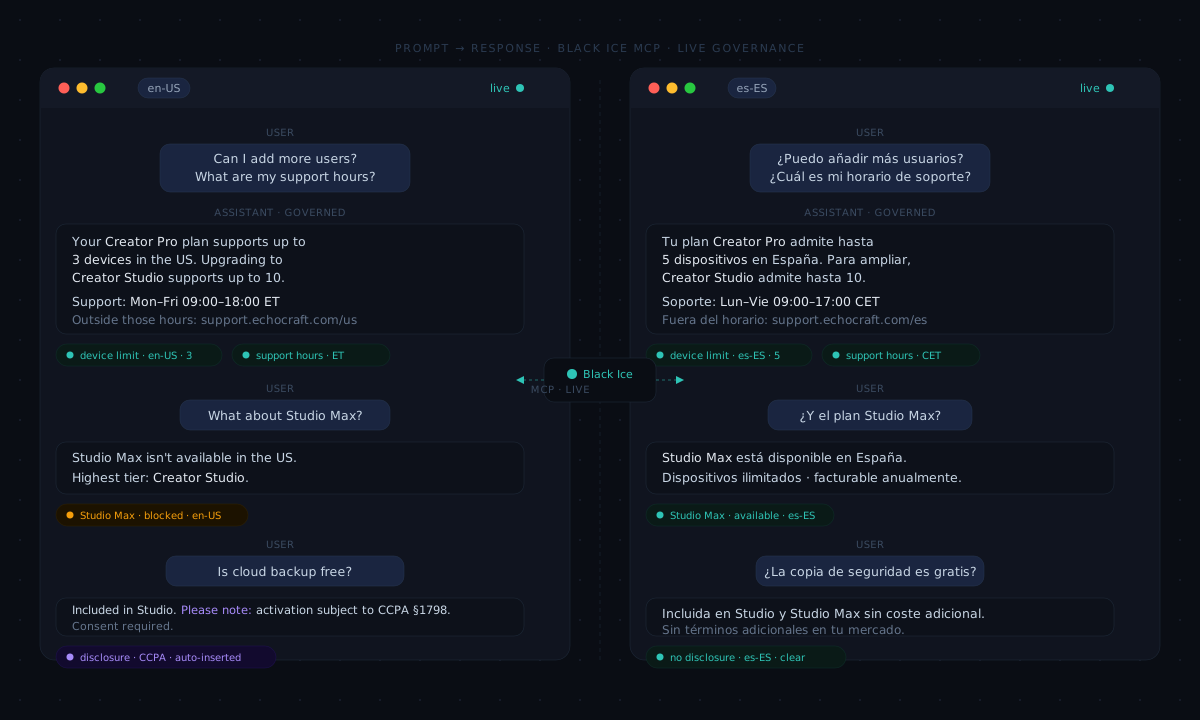
What an ungoverned assistant gets wrong every time.
Without structured market context, a conversational AI answers from training data and generic prompts. It gets the right language — and the wrong facts.
- Quotes the US device limit to a German user
- Mentions a plan that isn’t available in that market
- Omits a disclosure that’s legally required in France
- Gives global support hours instead of the local CET window
- Uses a deprecated product name from last year’s training data
- Describes a feature as "free" where local law requires a qualifier
- Device limits pulled from the live ontology per market
- Unavailable plans are structurally absent from the response
- Disclosures injected automatically when a concept is triggered
- Support hours reflect the locale’s actual staffing window
- Only approved, canonical terms are available to the model
- Output constraints per market encode what can and can’t be said
Not just terminology. Everything that differs by market.
Conversational AI operates across regulatory frameworks, support structures, and product configurations that vary enormously by market. Black Ice brings all of that into the assistant’s context — not as a static prompt, but as live, queryable structure.
Market availability
The assistant can only reference plans, features, and concepts that exist in the user’s market. If a plan isn’t available in that locale, it isn’t mentioned — not even to explain why.
Regulatory disclosures
When a governed concept is referenced in a regulated market, the required disclosure is injected automatically. The assistant doesn’t decide — the ontology does.
Support hours per locale
Support availability varies by market — different time zones, different SLAs. The assistant answers with the correct hours for the user’s region, not a generic global statement.
Plan limits and feature constraints
Device limits, seat counts, storage quotas, and tier-specific rules vary per market. Black Ice makes the right numbers structural, not advisory.
Voice, tone, and register
The Market Definition profile governs how the assistant sounds — formal vs. casual, approved formulations vs. patterns to avoid. A German assistant doesn’t use the same register as a US one.
Locked and forbidden terms
Deprecated product names, legally sensitive phrasing, and competitor terms that must never appear — governed at the concept level. The assistant cannot use a term that hasn’t cleared the ontology.
The ontology at inference time, not at deploy time.
Black Ice connects to your AI assistant via MCP or workspace API. When a user sends a message, the assistant queries the live ontology before generating — pulling the concept space, constraints, and market rules that apply to that user’s locale. Governance travels with the query, not with the deployment configuration.
- 01list_concepts · market=de-DE
Loads approved concepts for the German market — plans, features, limits — before the model begins generating.
- 02get_market_profile · locale=de-DE
Loads the German Market Definition — voice DNA, tone rules, support hours, output constraints. The assistant now knows how to sound and what it must never say.
- 03check_market_availability · concept=Studio Max
Returns not_available. The concept is removed from the response context before the model sees it.
- 04response generated · governed
The model generates freely — within the approved concept space for that market. Disclosures injected. Unavailable plans absent. The right support hours appear.
Four signals this is your problem.
- You ship a support chatbot, sales assistant, or copilot to users in multiple markets
- Regulated responses need a disclosure inserted automatically at inference time
- Your agents must never invent features, plans, or limits the market doesn’t offer
- You need an audit trail of which governance fired, for which concept, in which market
Live, not deployed
Ontology changes propagate to every assistant on the next query. No prompt rewrites, no redeploys, no stale configurations in production.
Structural compliance
Disclosures and constraints are enforced before the model generates. Compliance doesn’t depend on a well-written prompt or a human reviewer.
Full audit trail
Every governance event logged — which concept fired, which disclosure injected, which plan blocked, in which market, for which user.
Common questions about runtime AI governance.
Govern your assistant at the moment it speaks.
Book a 30-minute demo. We’ll walk through your assistant architecture, your markets, and exactly where Black Ice sits in the inference path.